Swap View
Open Swap/Bridge in the navigation to swap tokens or bridge them across supported networks. The swap interface uses a meta-aggregator: instead of routing through a single DEX, it requests quotes from multiple DEX aggregators at once and shows you the routes side by side.
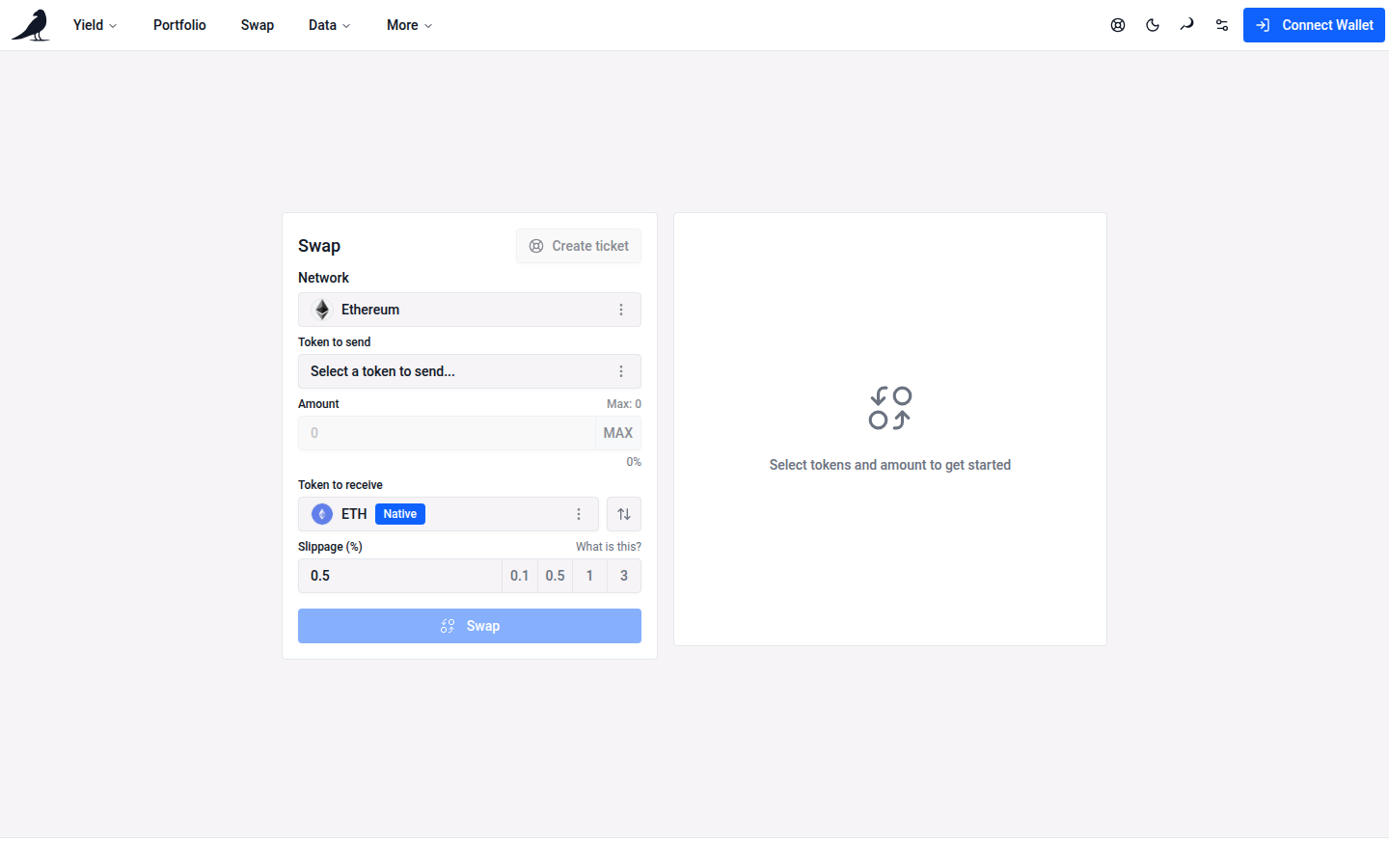
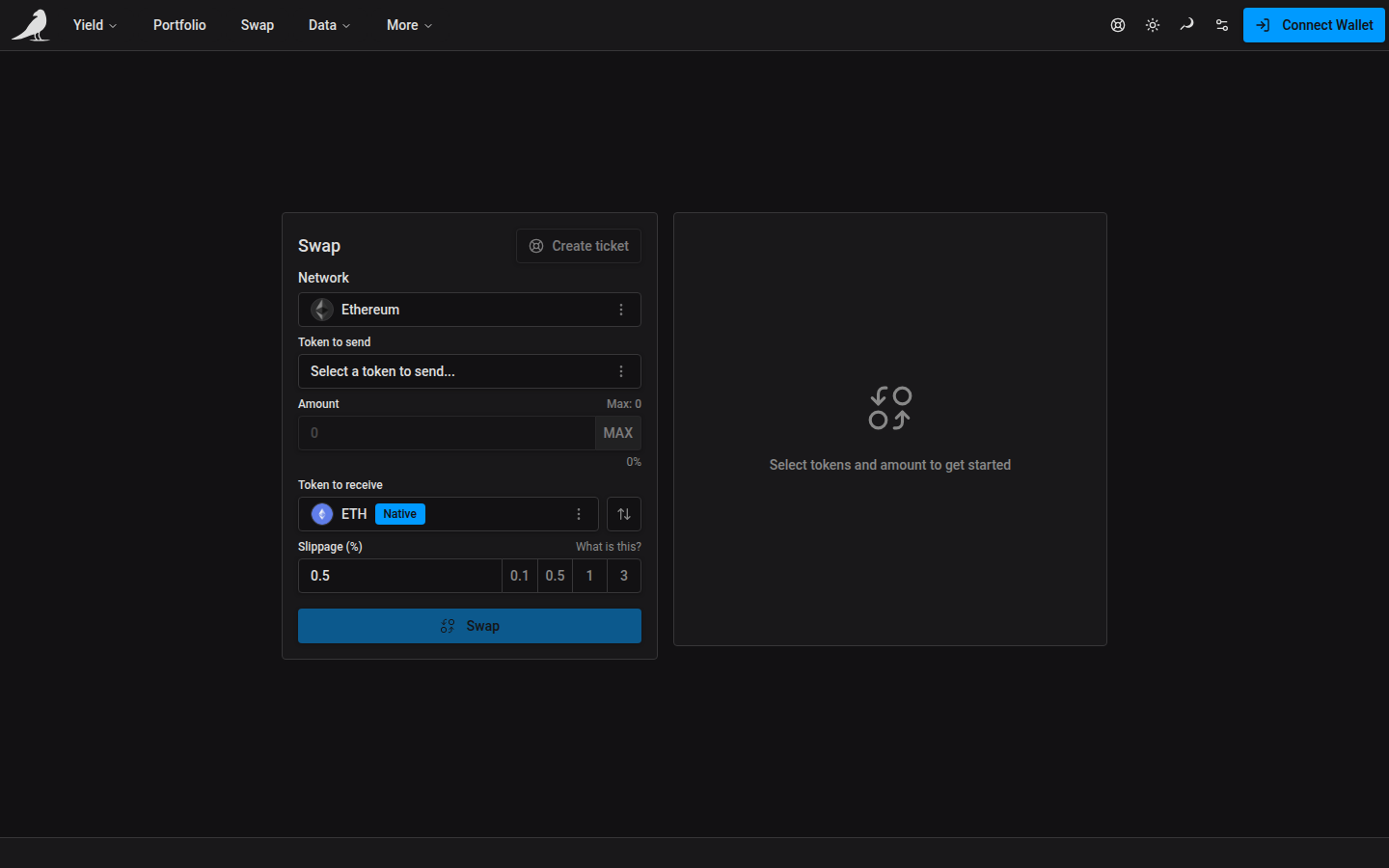
On desktop, the wider swap form and route comparison sit side by side near the top of the page. Their top edges stay in place as routes load, refresh or disappear. Short route lists fit their content; longer lists scroll while the panel header stays visible. Phones and smaller tablets use one wider panel with Back navigation between the form and routes. If a refresh returns no routes, the form reappears so you can adjust the swap. Resizing preserves your inputs and selected route.
Token pickers show tokens outside vfat’s whitelist in Unlisted tokens, below the other choices even if they have a balance or dollar value. Search by symbol or full address to find an unlisted token directly.
Choosing a route
On first load, the page picks the tokens but never an amount: nothing is filled in until you type it. It opens on the pair you used last in this browser. Otherwise, for a connected wallet, it picks the network holding the most value and the most valuable liquid token there. Tokens whose market holds less than 20 times your holding are skipped, which rules out lending receipts such as aTokens, as the deposit form does. If there are no suitable holdings, it starts from a common token such as USDC. You can change every selection before confirming; opening the page never submits a transaction. Tokens, networks, and amounts supplied in a shared link take precedence over these defaults.
The form shows straight away. While the complete token list loads, the token buttons show a placeholder; with your last pair, you can already type an amount and compare routes, and Swap becomes available once the list has loaded. Defaults and shared links are applied from the complete list, which also checks that your last pair is still listed; if it isn’t, the form starts from the defaults instead. If token loading fails partway through, select Retry token loading to resume without losing the shared link’s selections.
Choose the token and enter the amount in the You pay field. Your balance shows above it. The token picker, amount, token/currency toggle, and MAX share one row, just as they do for deposits and withdrawals; a long token symbol on the toggle is shortened, with the full symbol in its tooltip. The slider under the field sets a share of your balance; once you enter an amount, the share shows beside its value, for example 55% · ≈ $2,400. Then choose the token to receive under You receive. The network you swap on shows at the top of the form, with the destination network when you bridge. On desktop, each token dropdown matches the full input’s width; on phones, token choices open in a bottom drawer. In the token picker, search the start of a symbol or paste a full contract address. Search help explains the supported matches for the selected network.
Choose Connect wallet on the action button to connect. After connecting, the button indicates the next step, such as Loading tokens…, Choose a token or Enter an amount. It also shows when your balance is insufficient, routes are loading, or no route is available. Until you enter an amount, the routes panel shows where routes will appear; while quotes load, it shows placeholder rows. The arrow between the inputs swaps the send and receive tokens.
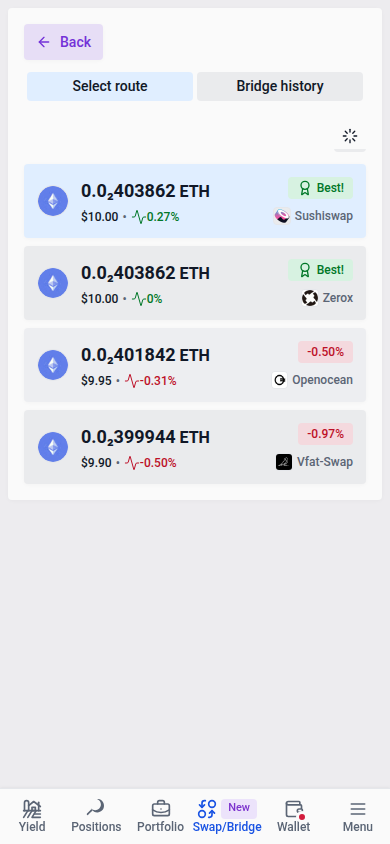
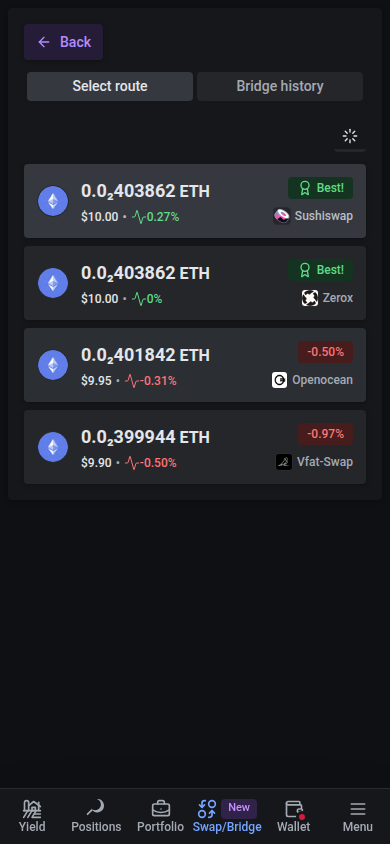
vfat.io fetches routes from several aggregators in parallel and opens a routes panel where you can compare and select among them before confirming. Routes appear from highest to lowest expected token output, using the exact token amounts rather than rounded dollar estimates. Each route shows its aggregator source so you can see where the quote came from.
The selected route is highlighted. Green Best! badges mark routes with the highest output; multiple routes can tie for best. Red percentage badges show how much less another route returns. These badges describe route output, separately from the price-impact value below the amount.
Tokens with transfer taxes
Some tokens take a fee on every transfer; see Fees. When the token to send or receive has a recorded transfer tax, the token picker and the selected token show a badge such as 1% tax, and a warning above Swap names the rate. Each route shows its estimated Transfer tax beside price impact.
The swap review lists the taxed transfers apart from the price-impact check: one when the token goes into the swap and one when it is delivered to your wallet. The estimate uses the token’s recorded rate on the quoted amounts. A route through more hops can pay more, and slippage applies on top.
Confirming a Curve swap
Curve quotes have a short on-chain expiry. After approval, vfat requests a fresh quote and checks its approval, minimum output, price impact and funding before opening your wallet. A new approval or price-impact decision can appear if those requirements change. If a delay uses up the quote’s lifetime, vfat requotes or asks you to retry. A refreshed expected output can fall within your original slippage tolerance; the new quote applies the same slippage setting to its current output. If the expected output falls below the original minimum or your selected provider is unavailable, start a new swap to get an updated quote. If your connected wallet changes while the quote is being checked, vfat blocks submission. Select a new quote with the wallet you want to use. Confirm the wallet prompt promptly; a transaction signed or included after the deadline can still revert.
Quotes with transaction fee limits
Some quotes require a particular wallet, network or maximum priority fee. vfat carries these conditions through fee preparation and checks the connected wallet and network again before requesting a signature. A zero priority fee is a valid limit. If the conditions no longer fit, vfat refreshes the quote or asks you to retry; refreshed swaps retain the approval, minimum-output and price-impact checks described above. The same checks apply to quoted swaps within Sickle actions.
Keep the supplied fee settings when confirming. Raising the priority fee in your wallet, speeding up a transaction, or submitting a replacement can change a pool’s fee and invalidate the quote. vfat controls the request it sends to your wallet; your wallet controls signing and later edits. A quote is not a guarantee of inclusion or unchanged pool state.
For a Safe or another smart-contract account, the connected account can differ from the transaction origin: an owner, relayer or bundler submits the transaction and sets its fees. Checking the connected account does not verify those submission conditions. Origin-dependent quotes cannot promise the same pool fee through those wallets; the transaction’s minimum output still applies.
Cross-chain swaps
Select a different network for the token to receive to swap across chains. Cross-chain swaps use Across; the destination picker shows networks supported for the selected source token. A route can include a swap before bridging, after bridging, or both. Review the minimum received and route before confirming.
Two protocol tokens bridge through their own protocols instead, as a direct transfer with no swap:
- xAERO on Ethereum, OP Mainnet, Arbitrum, Ink, Robinhood Chain or Arc redeems 1:1 for AERO on Base through Aero. The redeem burns the xAERO from your wallet, so it needs no approval. It only goes to Base.
- xVELO on a Velodrome chain bridges 1:1 to VELO on OP Mainnet, and VELO on OP Mainnet bridges to xVELO on those chains, through Velodrome’s bridge. You approve the bridge for the exact amount first. Routes go between OP Mainnet and one other chain only.
Both send a Hyperlane message whose fee is paid in the source chain’s gas token. The route card and transaction details show this native-token fee separately from the tokens you send; it is additional to source-chain transaction gas. Any nonzero dollar-denominated bridge fee is shown alongside it. An xAERO redeem usually arrives within a minute from OP Mainnet or Arbitrum and in about four minutes from Ethereum. The transaction flow tracks it to the destination transaction. These transfers do not appear in Bridge history, which lists Across transfers.
Bridge route cards identify the provider by name and logo: Aero uses the Aerodrome logo, Velodrome uses the Velodrome logo, and Across uses the Across logo.
Each bridge route shows the dollar value of its estimated output, then the percentage change from what you send, then the bridge fee and estimated time. When the route swaps tokens, the percentage compares the dollar value of the amount you enter with the value of the route’s estimated output at current token prices, so it covers losses in swap legs and the bridge fee together. If either token has no price, the change shows —. A direct bridge with no swaps delivers the token you send, so its percentage compares token amounts, and small price differences between networks don’t affect it. The percentage turns red when you receive less than you send.
Before submitting, vfat checks the estimated dollar value lost in the swap legs against your price impact threshold. This estimate uses quoted amounts and token prices and excludes bridge fees; it differs from a router’s pool price impact. Losses across legs are combined, and gains do not offset losses. Above the threshold, you must explicitly accept the risk to proceed, or pick a higher limit under Your limit in the same prompt, which saves it and checks the swap again. If a swap leg’s token prices are unavailable, submission is blocked. Transfers without swap legs do not need this check.
The transaction flow tracks the source transaction and destination delivery. If the destination swap fails, the bridged token is delivered instead of the requested output token, and the flow reports that fallback.
Finding and completing a bridge
Open the Bridge history tab beside Routes on the Swap page. On smaller screens, the tabs sit below the swap form and remain available before selecting a route. This view shows bridge transfers, including cross-chain swaps. Same-chain swaps, Sickle deposits, withdrawals, and keeper actions are excluded.
Bridge history covers every transfer from your wallet, newest first. Select Load older transfers at the bottom of the list to page further back. Recent bridge transactions may take a moment to appear. History is loaded from the API for your connected wallet; it is not saved in this browser. The database indexes bridge events continuously, even when you are not using vfat. The API reads those prepared records directly; opening history does not trigger indexing. Supported Across transfers made through other apps can also appear.
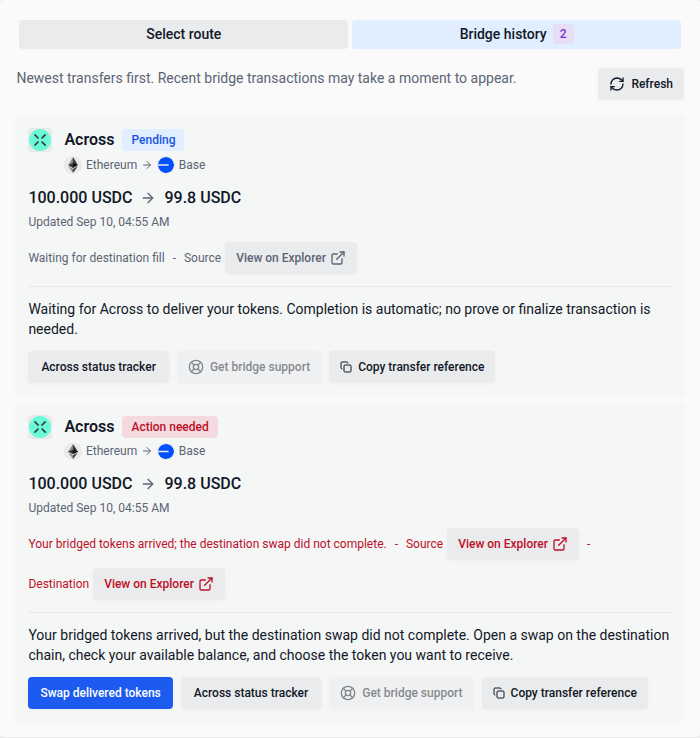
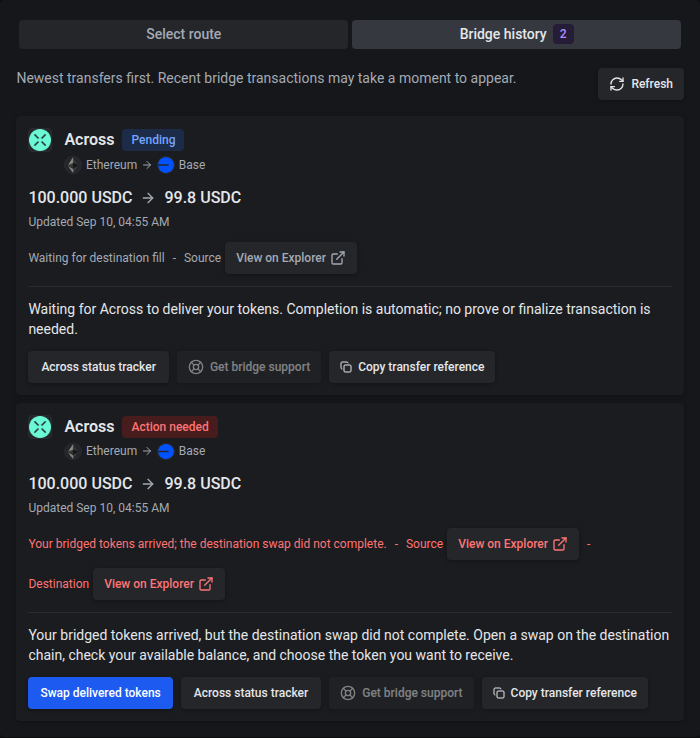
Each transfer shows the source and destination transaction links, its last known status, and the next step. While the Swap page is open, the most recent transfers refresh every 15 seconds when one is still in progress or you have just started a transfer, and every minute otherwise. Select Refresh to update all transfers you have loaded, including older pages, and remove records that the API no longer includes. The count on the Bridge history tab covers the most recent transfers only. If the API is temporarily unavailable, transfers already loaded on this page remain visible with an error message so you can retry. After a reload, reconnect, or wallet change, history must be loaded from the API again.
Across delivery is automatic. A slow fill or expired deposit stays in history while settlement or a refund is pending. Across status tracker and Copy transfer reference help you check progress. A failed destination swap offers Swap delivered tokens, using a fresh quote and your current wallet balance. Across transfers do not require you to prove or finalize a withdrawal.
Get bridge support attaches the transfer reference to a support ticket. Older Across refunds sent to a router require vfat support.
Wrap and unwrap
Wrapping and unwrapping a chain’s native token (e.g. ETH ↔ WETH) is handled as a distinct, gas-efficient path rather than being routed through an aggregator, since no swap is actually required.
Sharing a swap
The swap page keeps its state (tokens, amount, source and destination networks) in the URL, so you can copy the link to share a specific swap setup with someone else. Shared links retain that setup while network and token data load. They wait for the complete token catalogue before determining whitelist status. If token loading fails, choose Retry loading tokens to continue without reloading the page. This also retries failed token details for shared links, keeping the requested setup until loading succeeds. Tokens resolved from a link’s contract address without catalogue verification show the non-whitelisted warning. When you hide non-whitelisted tokens, these tokens are left unselected so the link respects your preference.